The Ultimate Guide to B2B Referral Marketing in 2026
B2B referral marketing is a superpower that can turn satisfied customers into brand advocates your company has left untapped. Response rates for outbound emails are dropping, and getting budgets for … The Ultimate Guide to B2B Referral Marketing in 2025
B2B referral marketing is a superpower that can turn satisfied customers into brand advocates your company has left untapped.
Response rates for outbound emails are dropping, and getting budgets for paid ads to attract customers is challenging. You can’t scale what your target audience is tuning out.
You need to build real trust and real use cases. That’s what referral marketing does because we trust what people we also trust recommend to us.
You’ll learn:
- What referral marketing looks like for your SaaS
- How it differs from affiliate programs
- How to set it up so it works without your team constantly monitoring it
Let’s start with the basics before we dive into strategy.
What is B2B Referral Marketing?
B2B referral marketing is a growth strategy where your existing customers refer new customers to your SaaS product. These referrals often come with rewards—like discounts, credits, or perks—for both the person making the referral and the person they refer.
It’s built on the idea of trust-based influence.
Instead of blasting cold emails or running LinkedIn ads, you tap into genuine relationships. People who’ve used your product, seen results, and are willing to vouch for it.
Establishing formal referral programs that incentivize businesses to recommend services or products to other businesses is crucial. B2B referrals foster long-term relationships and bring significant advantages, such as higher sales conversion rates and customer loyalty.
That makes referral marketing different from traditional acquisition channels: it’s not about reach; it’s about relevance. A single, high-intent referral can outperform dozens of unqualified leads.
So, how is this different from affiliate marketing?
They sound similar, and yes, there’s an overlap. But there are key distinctions that matter, especially for SaaS. Let’s break them down.
Why B2B Referral Marketing Works for SaaS Companies
Let’s be honest. Most SaaS growth channels are saturated. Paid ads are expensive. Cold outreach barely gets seen. But referral marketing? It still cuts through the noise.
Here’s why it works so well for SaaS, especially in building customer loyalty:
1. Referrals are built on trust
When someone recommends your product, they’re lending it their credibility. It’s not just another sales pitch; it’s social proof in action. That’s why referrals convert better than cold leads: they come pre-warmed by someone the prospect already trusts.
2. It lowers your Customer Acquisition Cost (CAC)
Referral marketing consistently drives high-quality leads without the high price tag, contributing to revenue growth. No bidding wars. No costly ad experiments. Just word-of-mouth at scale. And when you use the right tools to automate it, your cost-per-acquisition can drop significantly.
Tracking customer acquisition costs alongside metrics like referral volume and conversion rates ensures your marketing strategies remain effective and continue to drive high-quality leads.
3. It’s scalable (when done right)
Unlike influencer campaigns or manual outreach, a referral program can grow without adding more workload to your team. With the right setup, you can track signups, issue rewards, and manage the entire program on autopilot, enhancing customer retention.
That’s where referral platforms come in, amplifying your word-of-mouth marketing efforts. Tools like Reditus make it easy to run both referral and affiliate programs from a single dashboard—without dealing with messy duplicate tracking or clunky third-party setups.
It’s easy to assume referral and affiliate marketing are interchangeable. But look closer, and you’ll see that the differences matter, especially for B2B SaaS.
How B2B Referral Marketing Differs from Affiliate Marketing
Referral and affiliate marketing both rely on recommendations, turning satisfied customers into brand advocates, but they serve different purposes and audiences.
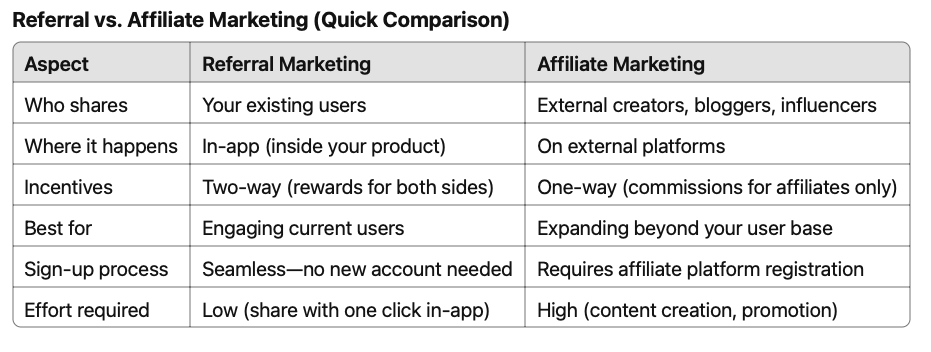
Why the difference matters
If you’re a SaaS company with active users who love your product, an in-app referral program is a low-effort, high-conversion way to grow.
But if you’re looking to scale beyond your current network, an affiliate program brings in new traffic. And managing affiliate links doesn’t have to be a hassle if your platform does the heavy lifting.
Do you have to choose between referral and affiliate marketing?
Not at all. Reditus gives you both in one dashboard—referral and affiliate—so you don’t need separate tools or deal with duplicate tracking issues.
You get total visibility, one embed, and fully integrated rewards and payouts. It’s the easiest way to run a hybrid strategy without doubling your workload.
If you’re thinking, “Okay, this sounds great, but how do I set this up?” Don’t worry; that’s precisely where we’re heading next.
How to Build a High-Converting B2B Referral Program in 5 Steps
Getting a referral program off the ground doesn’t have to be complicated or time-consuming. The key is to focus on simplicity, automation, and incentives that make people want to share.
Let’s walk through five steps to create a referral marketing strategy your SaaS can scale.
Step 1 – Define Your Ideal Customer & Referral Strategy
Before launching any kind of referral-based marketing, you need to know who you’re trying to reach, specifically identifying your potential customers. That starts with your Ideal Customer Profile (ICP).
Think about your most successful users:
- What industry are they in?
- What job titles do they hold?
- What pain points does your SaaS solve for them?
Building strong relationships with loyal customers is essential to enhance their overall experience and satisfaction, which drives referrals and business growth.
Once you’ve nailed this down, you can tailor your referral messaging and choose the right incentives to motivate action.
💡 Not every referral reward has to be cash. In B2B referral marketing, non-monetary perks like account credits, discounts, or even branded swag can also work (and cost you less).
Step 2 – Create an In-App Referral Experience
A high-converting referral program should feel like part of your product—not a separate tool. That’s why in-app referrals perform so well: they’re easy to access, easy to use, and completely frictionless.
Think of how companies like Dropbox or HubSpot let users invite others without ever leaving the app. Everything happens in one place—no third-party signups, no extra steps.
Offering attractive financial incentives, such as monetary rewards, can significantly motivate both referrers and referees, driving customer acquisition and fostering brand loyalty.
This approach is especially useful for companies like yours already running a SaaS affiliate network since embedding a referral software program directly inside your product adds another acquisition layer without needing a new platform.
Solutions like Reditus allow you to do just that by offering a built-in referral experience your users can trigger with a single click.
Step 3 – Automate Referral Tracking & Payouts
One of the biggest blockers for SaaS teams? Admin.
Manually tracking who referred whom, calculating payouts, and sending rewards is a nightmare at scale. That’s why automation is essential if you want to build a referral marketing program that grows without eating up your team’s time.
Using referral program software can automate and streamline your referral marketing efforts, integrating with CRM systems to track referrals and measure program success.
A solid B2B referral marketing software automates the entire process:
- Referral links are tracked from click to sign-up to payment
- Dashboards show real-time performance and conversion data
- Rewards are paid out through services like PayPal or Wise—no manual effort needed
If your team is already handling affiliate payouts, consolidating both programs makes even more sense. When you manage affiliate links through the same system, you avoid double-counting and messy attribution.
Step 4 – Promote Your Referral Program Effectively
Even the best referral program won’t perform if no one knows about it.
Use your existing marketing and customer success channels to make sure people see and use it:
- Email campaigns
- In-app messages or modals
- LinkedIn posts or newsletters
- Customer success touchpoints
Additionally, ensure your sales team is proactively involved in promoting the referral program. Their engagement is crucial for analyzing potential leads and measuring the effectiveness of referral strategies.
The key is to integrate your referral messaging into your existing motion—not treat it as a side project. This is the same principle that powers a strong affiliate marketing strategy—ongoing promotion is what drives long-term performance.
Step 5 – Optimize & Scale Your Referral Program
A referral program is never really “done.” You’ll want to monitor performance and run experiments regularly.
Creating a successful referral program involves showcasing effective examples and strategies. Promoting the referral program consistently and engaging customers throughout their journey can significantly enhance its success, ultimately leading to increased referrals and revenue.
Watch for:
- The percentage of users referring others
- Conversion rates from referred signups to paid accounts
- ROI compared to other channels like paid ads
Use this data to tweak rewards, test messaging, and learn what motivates your users to refer. This kind of iterative mindset is key to building a successful and scalable B2B referral marketing program.
And when you use the right platform to track referral sales, optimization becomes much easier, especially when both your referral and affiliate campaigns live in the same dashboard.
Great. You’re nearly there. But before you launch, let’s ensure you don’t trip over the common mistakes that hold most programs back.
Common Mistakes to Avoid in B2B Referral Marketing
Even with the best tools and intentions, referral programs can fall flat if a few key things go wrong. Here are some of the most common missteps SaaS companies make and how to avoid them.
Mistake #1: Offering incentives no one cares about
If your referral rewards don’t feel valuable, people won’t bother sharing. Too often, companies offer something vague or low-effort (like a $5 gift card) and expect high engagement.
Effective referral marketing strategies are crucial for driving business growth. Structured referral programs that engage customers throughout the buyer’s journey can lead to significant ROI and improved customer acquisition.
For B2B marketing referral programs, your incentives should align with what your users actually want.
That could be product credits, an extended free trial, or a meaningful discount. Sometimes, a well-designed monetary reward works—but it has to feel worth it.
Mistake #2: Making the process too complicated
If users have to click through three modals, log into another platform, and copy/paste a code, they’ll give up. Streamlining the referral process is crucial; simplifying the steps involved in referring others can significantly enhance customer engagement and acquisition.
The best b2b referral marketing toolssimplify this into a single in-app experience. With platforms like Reditus, your users can access their referral link and share it in seconds—no friction, no separate accounts, no confusion.
If you’re still evaluating platforms, it’s worth weighing the pros and cons of affiliate marketing versus in-app referrals, especially when it comes to ease of use and user experience.
Mistake #3: Not tracking or managing referrals properly
Tracking referral performance in a spreadsheet might work for a few dozen users but not at scale.
You need visibility into who’s sharing, who’s signing up, and whether those signups are turning into paying customers. Without that, you’re flying blind.
Fostering relationships with referrers is crucial to optimize the potential for successful referrals, as it encourages ongoing engagement and appreciation.
A modern b2b referral marketing program should come with built-in analytics, smart attribution, and automated payouts so you can focus on growth, not admin.
Mistake #4: Thinking you can “set it and forget it”
Referral marketing isn’t just a plug in-and-walk-away feature. To get results, you need to monitor performance, test different incentives, and promote the program consistently.
Implementing a successful referral program is crucial as a strategic tool for B2B businesses. It involves engaging throughout the buyer’s journey.
That way, you can ensure compliance with relevant laws and clearly communicate program terms to build trust and integrity, ultimately generating new leads and customers.
This is where having a clear referral marketing strategy for B2B businesses makes a difference. It’s not just about launching. It’s about nurturing, optimizing, and scaling over time.
Avoiding these pitfalls sets the foundation for a referral engine that delivers results.
So what’s next? Let’s recap what you’ve learned—and why now’s the time to launch your own referral program.
Over to You: Your Next Customer Is One Referral Away
If you’re looking for a scalable, low-cost, high-trust growth channel, B2B referral marketing is it.
You don’t need a massive budget. You don’t need a full-time team managing spreadsheets and payouts. And you don’t need to guess whether it’s working.
With the right approach, your SaaS can build a referral engine that runs quietly in the background, bringing in leads who already trust you, convert faster, and cost less to acquire.
You’ve now got the essentials:
- A clear understanding of what referral marketing looks like in B2B SaaS
- How it compares to affiliate marketing (and when to use both)
- A step-by-step plan to build, automate, and scale your program
- And how to avoid the mistakes that trip up most companies
Whether you’re launching your first B2B marketing referral program or levelling up an existing one, now’s the perfect time to start.
And with Reditus, you don’t have to choose between referral or affiliate. You get both—in one clean, scalable dashboard explicitly designed for SaaS.
B2B Referral Marketing FAQs
1. What is B2B referral marketing?
B2B referral marketing is a strategy where your existing customers refer new leads to your product or service. It’s based on trust and often includes rewards for both the referrer and the new customer.
2. How does referral marketing work for SaaS companies?
In SaaS, referral marketing typically runs through an in-app system where users can share a referral link. When someone signs up or becomes a paying customer, both parties receive rewards like credits, discounts, or commission.
3. What’s the difference between referral marketing and affiliate marketing?
Referral marketing is user-driven and happens inside your app, while affiliate marketing involves external partners promoting your product through content or outreach. Affiliates usually earn commission; referrals often include two-way rewards.
4. What’s the best referral marketing software for B2B?
The best referral marketing tools for B2B are ones that combine automation, in-app integration, and affiliate functionality, like Reditus. It’s built for SaaS companies and simplifies both referral and affiliate programs.
5. How do I create a successful B2B referral marketing program?
Start by identifying your ideal customer, choose the right incentives, and make it easy for users to share links in-app. Use referral tracking software to automate payouts, monitor performance, and continuously optimize the program.

Meet the author
Back in 2020 I was an affiliate for 80+ SaaS tools and I was generating an average of 30k in organic visits each month with my site. Due to the issues I experienced with the current affiliate management software tools, it never resulted in the passive income I was hoping for. Many clunky affiliate management tools lost me probably more than $20,000+ in affiliate revenue. So I decided to build my own software with a high focus on the affiliates, as in the end, they generate more money for SaaS companies.

Affiliate Agreement Monitoring: 7 Key Things to Know
Affiliate marketing is powerful, but only if it’s well-managed. Even the best-written affiliate agreement is just a static PDF if no one’s enforcing it. In the world of B2B SaaS, … Affiliate Agreement Monitoring: 7 Key Things to Know
How to Manage Affiliate Marketing: A Complete Guide for SaaS Companies
Affiliate marketing has come a long way from shady banner ads and mass coupon sites. For SaaS companies today, it’s a strategic channel that can drive real revenue, expand reach, … How to Manage Affiliate Marketing: A Complete Guide for SaaS Companies
18 Best AI Tools For Affiliate Marketing in 2026
AI isn’t coming for affiliate marketing because it’s already here. From crafting high-converting copy to refining SEO, automating outreach, and measuring performance, AI tools are transforming the way affiliate marketers … 18 Best AI Tools For Affiliate Marketing in 2025